

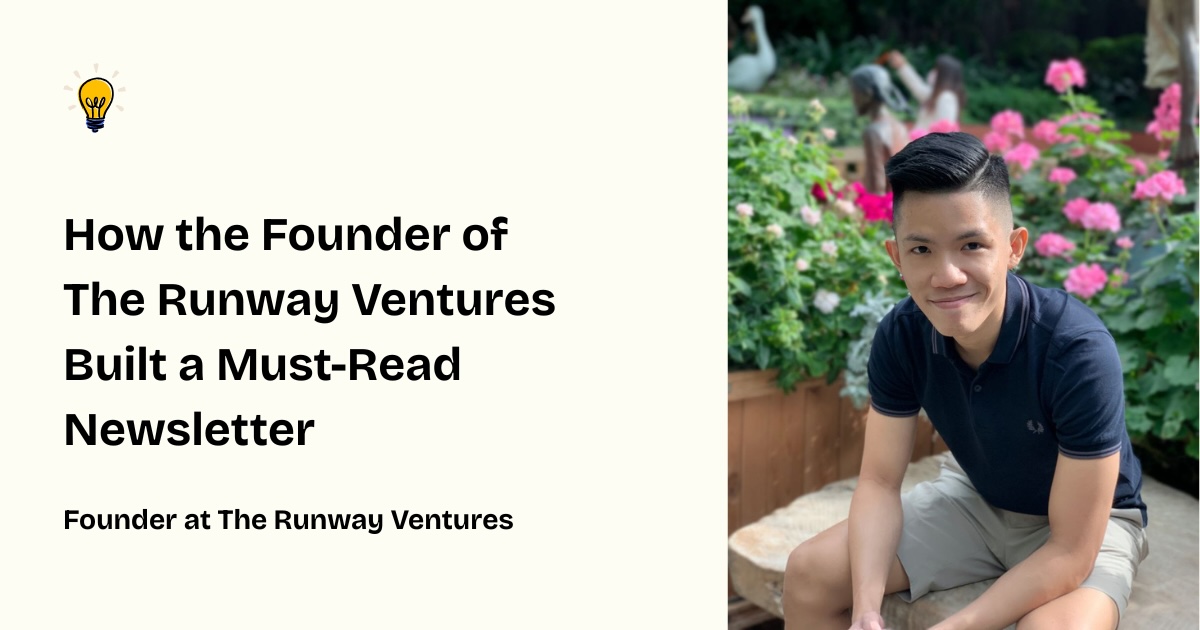


In a startup world obsessed with success, Admond Lee, founder of The Runway Ventures, built his influential newsletter by focusing on the opposite: failure. His deep dives into why startups don’t make it have become an essential resource for founders learning what to avoid.
But how did he turn this unique idea into a must-read publication?
We wanted to know the story behind the story. So, we sat down with Admond for a tactical, no-fluff conversation about the art and science of building a newsletter from the ground up.
In this interview, he shares his complete playbook: the specific steps he took to get his first 100 subscribers, the system he uses for creating high-quality content week after week, and the single most effective strategy that took him to his first 1,000.
We also get into the nitty-gritty of monetization, the essential tools he’d use on a tight budget, and the growth experiments that didn’t work out. If you’ve ever thought about launching a newsletter to build a community and grow your brand, this is for you.
What was the specific moment or realization that made you decide to start The Runway Ventures, especially when there were already other tech newsletters out there?
I started The Runway Ventures after my first startup failed terribly. Why? I still remember when I asked other founders for startup advice, every founder shared with me their success tips and their biggest achievements. Almost no one shared with me their biggest failures or mistakes.
When my first startup failed, I was confused. I followed all the “success” tips shared by other founders, why did I still fail? And that was when I realized 2 things:
- There are many ways to succeed, but there are only a few ways to die. If I didn’t make costly mistakes, my first startup would have survived (maybe).
- Learning from mistakes is costly. Learning from other people’s mistakes is leverage.
If mistakes are the best teachers, why no one is talking about this? That’s when I saw a gap. After exploring many tech newsletters in the market, I couldn’t find a newsletter that talks about failed startup stories in Asia.
If I struggled to find a newsletter to learn from startup mistakes, I believed most founders would face the same problem too. That’s when I started The Runway Ventures – a weekly newsletter to help founders learn from failed startup stories and become better operators.
It’s time to fix the startup ecosystem.
Can you walk me through the specific, step-by-step actions you took to get your first 100 subscribers?
- Positioning
- To attract founders to read my newsletter, I first need to position myself as a go-to “failure” guy on LinkedIn.
- So I started writing about my own failures, mistakes and lessons learned on LinkedIn.
- The goal – When founders think of learning from startup failures, they need to first think of Admond / TRV.
- Staying top of mind is the game.
- LinkedIn
- LinkedIn posts
- In the beginning, I started posting on LinkedIn by writing how my first startup failed and what I learned from the painful experience.
- The post got early traction which further reinforced my belief to continue writing the newsletter.
- Because I also included a CTA link in my posts, that’s how I got my early subscribers.
- DM every founder in my network
- I used PhantomBuster to automatically DM every founder in my LinkedIn’s first connection network with a CTA to subscribe to TRV.
- This approach helped me get many early subscribers.
- LinkedIn posts
- Facebook groups
- There are a few highly engaged FB groups that talk about startup or entrepreneurial topics in Singapore and Malaysia.
- So I first started by sharing my personal startup stories, challenges, mistakes and lessons learned to add value to the community.
- After a few posts, I then share a few failed startup stories that I wrote with a CTA link to subscribe to TRV.
- Because people already knew my background and trusted me as a person, I got quite a few early subscribers from these FB groups.
What is your system for consistently finding and creating high-quality content that resonates with your audience week after week?
I mainly use 3 different data sources:
- Primary data source : Interview founders, employees, investors or other stakeholders to get a balanced view of a startup story (and why it failed).
- Secondary data source : I read other reputable sources like Tech in Asia, Bloomberg, Tech Crunch, and e27 etc.
- Tertiary data source : Community forums, Reddit, FB groups, founder friends etc.
After your initial launch, what was the single most effective strategy or channel that took you from 100 to your first 1,000 subscribers?
LinkedIn and FB groups were the 2 main organic channels (and they still are) that grew from 100 to 1,000 subscribers and beyond. The main strategy used was to always add value to the community first before asking them to subscribe. Everything becomes easier once the trust is built.
BONUS: Here’s another strategy that I’ve been using:
- Pre-CTA
- 1 day before my newsletter is published, I’ll write a LinkedIn post to give a teaser (preview) of what I’m going to share in my upcoming newsletter.
- The post would end with a CTA link so that interested founders can subscribe to TRV to read it firsthand before anyone else.
- This works extremely well. I got 1,000+ subscribers with this approach.
- Post-CTA
- 1 day after my newsletter is published, I’ll write another LinkedIn post to give a summary of my newsletter (glimpse of the failed startup story).
- Again, the post would end with a CTA link (to the story) so that interested founders can click and read it.
- Because the content on TRV website is gated (free but only available for subscribers), non-subscribers would have to subscribe to TRV in order to read the full story.
How do you measure the success of an issue? Is there a particular metric beyond open rates, like reader replies or feedback, that tells you you’ve hit the mark?
My only success metric is content-market fit (CMF). And the only way to know if I’ve achieved CMF is by looking at:
- Open rate: > 40%
- Click-through-rate: >5%
- Positive reader replies and feedback (email / LinkedIn)
When did you first feel like The Runway Ventures was gaining real traction and becoming a sustainable project? What did that feel like?
The moment when TRV hit >5,000 subscribers organically with high engagement rates, that was when I started taking it seriously. It felt magical because I started TRV to solve a problem that I faced, and it just happened that many other founders are facing the same problem – which is struggling to learn from other startup (or founder) mistakes.
This is especially true in Asia where most founders tend not to share about their failures and mistakes. So TRV, to me, is a platform for every founder to learn from startup mistakes and become better operators.
If one founder avoids making costly mistakes, and builds a successful business, TRV has done its job right.
What is one task or part of running the newsletter that you spend a lot of time on but that most readers would probably never realize?
Content. In Asia, writing fundraising news or successful startup stories is easy. You write, you publish. Founders are happy, investors are happy. Everyone is happy.
Unfortunately, writing “failed” startup stories is never easy. We write, we publish. Sometimes founders are not happy (might send lawyer letters), investors are not happy (because of reputational risk). So nobody is happy.
That’s the reality. That’s the constant battle I’m fighting and trying to balance. It’s not easy. But if TRV doesn’t do it, there would only be more founders making the same costly mistakes that would have been avoidable in the first place.
For founders thinking about monetization, what’s your advice on when and how to start? Should you have a plan from day one or wait for significant growth?
Always start with what you’re passionate about (ideally the problem that you want to solve) and make sure the market is big (or niche). You should plan from day 1 on how you plan to monetise your newsletter.
For TRV, we’re monetizing in 4 ways:
- Ad sponsorship: Brands (i.e. Notion, Deel, HubSpot) sponsor TRV because they want to target B2B founders in Asia to acquire high-value leads and customers.
- Affiliate marketing: We get paid through affiliated products and newsletters.
- Events: We organize Startup Fxckups events (ticket sales + sponsorship) where we invite high-quality founders to meet and learn from each other’s experience and mistakes.
- By the way, we’re hosting the next Startup Fxckups dinner on 18 September (Thur) at 7:30pm in Singapore.
- If you want to join a hand-picked circle of founders, sign up here (get 12% off with this promo code “TRVSTARTUPFXCKUPS”)
- Private founder community: A private, curated community for revenue-generating founders who learn fast, move faster, and win together.
- If you’re doing $50K+ a year and you’re serious about building a durable, profitable company with like-minded founders, this is where you belong. Join us here.
If you had to start over on a tight budget, what are the absolute essential tools you would use to launch and run the newsletter?
Having a newsletter alone is not useful if no one knows your newsletter exists or wants to read your newsletter. So I’ll focus on 2 things – content + distribution.
On Content:
- I’ll use ChatGPT / Perplexity / DeepSeek to help me research, summarize, and write newsletter content for me.
- After that, I’ll tune the content to fit my voice and style.
On Distribution:
- I’ll test and find ONE organic social channel that can help me attract the right subscribers.
- Because my target audience is founders, LinkedIn is the best organic channel to start with.
Beyond the successes, could you share a specific growth experiment or content strategy that didn’t work as expected, and what was the key lesson you took away from that failure?
I burned $5k on Meta ads to get 6,000 new subscribers. Then deleted 3,428 of them. In October 2024. The Runway Ventures just hit content-market fit. 12k highly-engaged founders reading every issue.
My SG and MY Meta ads were crushing it:
- CPC under $2
- 45% open rates
- Readers actually engaging
So I did what any founder would do. I added Indonesia to the targeting. The result? CPC dropped to $1. I thought I cracked the code. So I doubled down and tripled the budget. I got 6,000 new subscribers in 8 weeks. My subscriber count shot from 12k to 18k.
When I checked the actual engagement metrics.
- Open rates: 45% → 30%
- Click rates: Dead
- Unsubscribes: Through the roof
I’d optimized for the wrong metric. Built a vanity metric machine instead of a newsletter. $5k spent attracting readers who didn’t actually want to read. The cleanup was brutal. Manually removing thousands of subscribers. Watching my “growth” disappear. Explaining to myself why going backwards was actually progress.
But here’s what that $5k taught me:
- Geography matters more than price : Different markets have different content appetites. A $1 CPC means nothing if they don’t engage.
- Vanity metrics will kill your business : 18k subscribers sounds impressive. 12k engaged readers builds an actual business.
- Quality beats quantity every time : Better to have 100 readers who read every word than 10,000 who never open.
As your audience grows, how do you think about building a true community around the newsletter versus simply growing a subscriber list?
Organizing Startup Fxckups events is how I want to build a true community. Building an online community (i.e. subscriber list) is one thing, but the true magic lies when we connect our community members together offline.
In short, I believe people are still craving for genuine human connection, and this can only happen when we host offline events. Not easy, but worth the effort.
So the game plan here is to start online, then connect offline.
Looking ahead, do you see The Runway Ventures evolving into something more than a newsletter. Perhaps a full-fledged media brand, or something else entirely? How are you thinking about its long-term vision?
The vision for TRV is to become the biggest startup newsletter in Asia. While we’re striving towards that direction, TRV will also become the go-to platform for founders to:
- Access knowledge (failed startup stories)
- Access resources (how-to guides from 0-1 and 1-100)
- Access network (connect founders-founders / founders-investors)
- Access talents (find your ideal employees easily)
- Access capital (connect founders-investors + angel syndicate fund)
- Access tools (get the right tools with steep discounts / free)
Writing failed startup stories is just the beginning, and we’re just getting started.
If you could give one core piece of advice to a founder using a newsletter for growth, what would it be?
Newsletters, especially in Asia, are still very underrated.
While social channels like LinkedIn and X are great for founders to grow, the community there is a rented audience. If these platforms decide to ban your accounts for whatever reasons, your rented audience is gone – and that’s it.
Newsletters, on the other hand, help you own your audience. Nobody can take away the subscriber list from you. Assuming someone subscribes to your newsletter with a valid personal email address, how often do you think the person would even change his/her email address?
5 years? 10 years? I don’t have the answer. I just know that I’m still using my personal email address even after more than 10 years.
In short, as a founder, I’d strongly recommend leveraging both socials (i.e. LinkedIn) for distribution and newsletter for building trust and eventually monetizing your audience.