

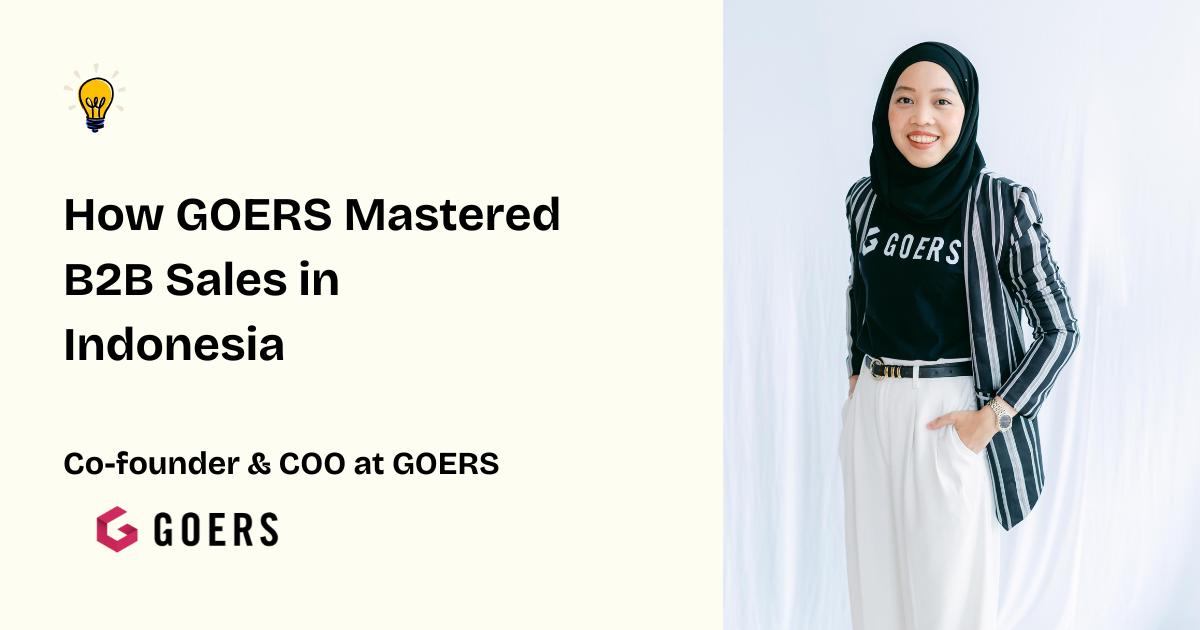


I’m thrilled to share an upcoming interview with Niki Tsuraya, the co-founder and COO of GOERS.
GOERS has become one of Indonesia’s leading technology platforms for the leisure and entertainment industry, providing everything from ticketing and management solutions for event organizers to a discovery platform where users can find and book tickets for concerts, attractions, and workshops.
Niki has been in the trenches, building this successful tech company from the ground up in Indonesia. She was generous enough to share incredible insights from her journey, her sales strategies, and her advice for founders looking to follow in her footsteps. Below is our full interview.
Could you share an experience from your journey with GOERS where a sales approach fell flat, and what was the key lesson you learned from it about doing business in Indonesia?
There were periods when our growth was slow because we relied on a door-to-door approach with a small sales team and did very little digital promotion, assuming online channels were only effective for B2C. We also learned that adoption speed differed by industry—events moved fast while attractions took longer—and that our true B2B audience was at the GM or executive level. These insights forced us to refine our strategy: balance offline and online channels, tailor the approach by industry pace, and engage directly with top decision-makers—ultimately allowing us to accelerate growth with a more focused and effective sales motion.
How critical was “founder-led sales” in the beginning for GOERS? Did you find that being the founder gave you unique access to decision-makers that a typical sales representative might not have had?
Extremely critical. As founders, we had the deepest understanding of why GOERS exists: to empower organizers and attractions to digitize their ticketing, payments, and on-ground customer experience. That conviction is hard to transfer in the early stage, so being in the room personally made a big difference. It also gave us access—executives are more willing to meet a founder than a junior sales rep. Over time, the challenge was to translate this vision into training so our sales team doesn’t just “pitch features” but also communicates the bigger picture of how digitalization can transform the way Indonesians experience events and attractions. And of course, as a founder or C-level executive, we can make strategic decisions faster, which accelerates the process compared to a sales representative with limited authority.
In Indonesia, relationships are everything. Can you give a specific example of how a casual “ngopi-ngopi” (coffee meeting) or an informal chat led to a significant breakthrough or partnership for GOERS?
Yes, relationships are key in any business in Indonesia, and ngopi-ngopi is often the gateway. In a relaxed setting, without slides or the pressure of a formal pitch, people open up more freely about their real needs, ideas, and frustrations. One of our first large-scale event clients came from exactly this kind of chat—what started as casual coffee turned into a discussion about long queues and manual processes, which led them to try GOERS and eventually become a long-term client. Many times, these conversations also opened doors to hidden opportunities, especially referrals to other events or even connections to talent we later brought on board.
Trust is earned over time. Beyond delivering a great product, what are some specific actions you took to build deep, lasting trust with your early clients that turned them into long-term partners?
For events, trust comes from responsiveness—organizers work on tight timelines, so showing up in crunch moments makes all the difference. For attractions, it’s about consistency. Many already have legacy systems, so they need to know we’ll still be there after go-live, not just during the sales cycle. Listening is key too—complaints are often the biggest gift, because solving them quickly proves reliability.
This was especially clear during COVID, when we helped attractions manage visitor capacity and keep doors open by rapidly adapting our system to new needs. More recently, when demonstrations in Jakarta forced sudden event cancellations, we waived refund fees to support organizers. These moments—innovating under pressure and standing by clients in tough times—are what turn transactions into long-term partnerships.
How did you learn to navigate the complex corporate hierarchies and the “Bapak/Ibu” culture, especially when dealing with larger, more traditional companies?
We always start with stakeholder mapping. In some cases, we meet directly with top management, especially when digitalization is a clear strategic priority. But in Indonesia’s “Bapak/Ibu” culture, respect for hierarchy is essential. Even with executive sponsorship, skipping stakeholders like operations, finance, or IT can create friction later. That’s why we engage every layer, align concerns, and keep leaders in the loop—while also respecting each company’s culture and procedures. When the final decision comes, it feels collective, not imposed, which makes partnerships last.
Can you share an instance where you had to interpret what wasn’t being said in a meeting to understand a client’s real concerns or objections?
This often comes up in pricing discussions. At one attraction, the management team was enthusiastic during our demo, but when we moved to commercial terms, their body language and the slower pace of conversation revealed hesitation. They never said ‘the price is too high,’ but we sensed it. By proactively offering flexible models—like volume-based tiers—we reopened the discussion. It showed them we were partners, not just vendors pushing a fixed package.
What’s your philosophy on negotiation in the Indonesian context? How do you balance demonstrating the value of your service with the common expectation of finding a flexible price?
The most important principle in negotiating with a potential partner—especially for long-term collaboration—is to ensure all parties benefit. Negotiation is not about winning or losing, but finding a win-win. Our clients are not adversaries to outmaneuver; they should feel they gain real advantages by working with us. That’s why we set clear boundaries while staying flexible to their needs. At the same time, we make sure to articulate the distinct value of our services—seamless ticketing, integrated payments, and real-time insights that directly strengthen revenue and operations. By balancing flexibility with proven value, we build partnerships that are fair, sustainable, and built on trust.
As GOERS has grown, how have you managed to scale a highly personal, relationship-driven sales approach? How do you train your sales team to build genuine connections, not just follow a script?
For us, scaling relationships means deeply understanding our partners’ operations. With events, it’s not just about ticket surges—it’s the constant changes before, during, and after the event, where empathy and speed matter most. With attractions, it’s about modernizing daily visitor flows and being reliable over time. To scale that trust, we combine people and systems to ensure consistent communication, service, and reporting. And we anchor everything on three values: integrity, professionalism, and sincerity—so every client feels genuinely supported, not just “sold to.”
What channels, tools or platforms have been most effective for you in generating meaningful B2B leads and connections within the Indonesian ecosystem?
We’ve found that joining industry associations and being visible in event and tourism communities is powerful. Our best leads often come from word-of-mouth or referrals after successfully powering one event or attraction. LinkedIn is effective for mapping decision-makers, but it’s the combination of digital presence plus on-ground credibility—proven at actual events/attractions—that truly generates meaningful leads.
From your perspective, what is the single biggest mistake you see foreign founders make when they first try to sell their product or service in Indonesia?
The biggest mistake is assuming what worked abroad will work here. Success stories from other countries don’t automatically translate to Indonesia’s unique culture and realities. For example, models that thrive elsewhere often need far more education, support, and trust-building here. Without adapting, foreign founders risk resistance instead of adoption.
Finally, if you could give one piece of counter-intuitive advice to a founder about to make their first sales call in Indonesia, what would it be?
Don’t obsess over closing fast. I’ve had moments of frustration when deals didn’t move as quickly as I hoped. But my CEO and MD reminded me: planting seeds matters just as much as harvesting.
That lesson still holds true today—especially now that we’re working with more enterprises and brands. Through education, trust-building, and showing up even when there’s no immediate deal, the seeds you plant today will eventually bear fruit.