

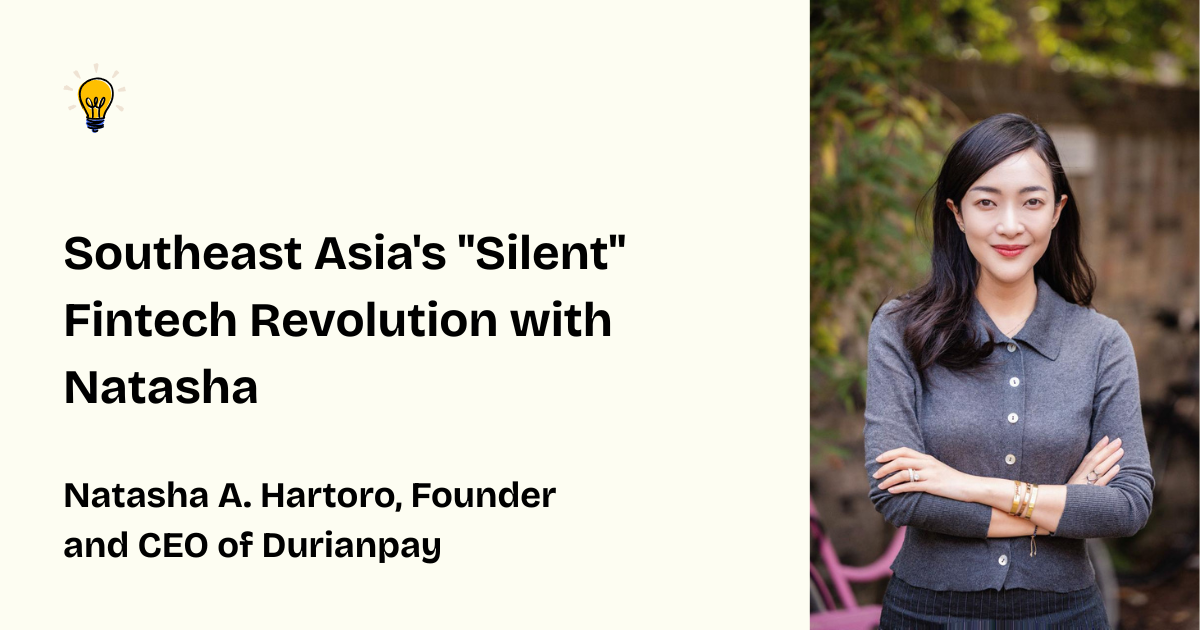


While Silicon Valley obsesses over “crypto-native” apps, the real revolution in Southeast Asia is happening in the back office. It isn’t loud, it isn’t speculative, and it’s being led by fintech operators who understand that in markets like Indonesia, infrastructure is king.
One of the key architects of this shift is Natasha A. Hartoro.
As the Founder and CEO of Durianpay, Natasha has built one of the fastest-growing B2B payment orchestrators in the region. Durianpay doesn’t just process payments, it stitches together the fragmented landscape of e-wallets, bank transfers, and cards into a single “one-stop” API for businesses.
But the next frontier isn’t just domestic, it’s cross-border. With stablecoin adoption in Southeast Asia outpacing much of the West, regulated fintechs are beginning to explore how these “digital dollars” can run on the backend of traditional commerce.
In our upcoming deep dive, we are sitting down with Natasha to ask the hard questions about how money actually moves in 2025.
Do you see stablecoins simply as a “faster SWIFT” for backend settlement, or do they fundamentally change the business model for fintechs in Southeast Asia?
Stablecoins are already more than a faster SWIFT. SWIFT is messaging. Stablecoins are settlement. That alone flips the economics. In Indonesia, speed is not the only pain point. It’s the fragmentation, the cut-off times, the fees that stack like a bad Jenga tower, and the reconciliation headache afterward.
Stablecoins let fintechs compress collection, FX, and settlement into one programmable layer. That changes unit economics for cross-border operators and allows smaller fintechs to offer services that previously needed deep banking relationships. The value doesn’t show up in the app. It shows up in margin improvements, liquidity optimization, and fewer gray hairs for your finance team.
How much friction does the traditional banking calendar actually create for a payments orchestrator, and can 24/7 stablecoin rails realistically solve this liquidity gap for merchants?
In Indonesia, cut-off times are a tax. If you collect on Friday night, the money basically goes into hibernation until Monday. Weekends and public holidays turn into involuntary treasury retreats.
For a payment orchestrator or payment gateway like us, this delays settlement to merchants, forces us to keep bigger float buffers, and creates downstream reconciliation delays.
Stablecoins give you a release valve. You can sweep liquidity 24/7, including during holidays. It doesn’t magically remove the domestic clearing calendar, but it lets you move value across borders continuously so you don’t end up cash-strapped at the worst time. Merchants feel the difference because their settlement becomes much more predictable.
How are fintechs using stablecoins behind the scenes to handle cross-border payments, and is this changing their reliance on banks and FX fees?
Most regulated players don’t use stablecoins at the consumer layer, at least at this point. They use them as an invisible settlement leg. Think of it as a teleportation hop to move USD value from Singapore to Indonesia or vice versa, then convert at the edge.
The biggest savings aren’t from skipping banks. You still need licensed partners. The savings come from eliminating the correspondent banking ping-pong and minimizing spreads. You’re basically short-circuiting two or three unnecessary hops.
Banks stay in the loop but play a more specialized role. Meanwhile, FX margins shrink, settlement windows shorten, and operability becomes predictable.
Indonesia has high crypto adoption but bans direct crypto payments. How does a regulated player like Durianpay bridge this gap?
Indonesia’s rule is clear: you can trade crypto, but you can’t buy a coffee with it. For regulated players, the trick is to respect that boundary while still using digital assets where the regulator is comfortable.
We treat stablecoins as a backend settlement tool. They’re never used as a payment instrument to merchants. Durianpay handles on- and off-ramps through licensed exchanges, keeps strict AML controls, and ensures every step ends in fiat for the merchant. It’s boring by design but it’s the only way to scale sustainably in Indonesia or any other country that doesn’t treat crypto/stablecoin as currency.
Do you view regional QR connectivity and stablecoins as competitors for cross-border dominance, or do they serve completely different use cases?
They serve different use cases today, but the lines are definitely starting to blur. QR connectivity is the consumer layer. It solves a very real travel and retail problem across ASEAN. A Thai tourist scans in Bali, an Indonesian student pays in Singapore, and no one worries about currency conversion. It’s familiar, it’s regulated, and it’s already live across the region.
Stablecoins started off as pure infrastructure, the quiet backstage where B2B settlement gets faster and cheaper. But if you look at Singapore or the US, you can already see the consumer layer rising. You’ve got USD stablecoin-powered credit cards, wallets that function like crypto neobanks, and merchants accepting stablecoins directly. Once consumers get comfortable with digital dollars in one market, it tends to spill over into the region.
So I don’t see QR and stablecoins as rivals. QR is the front door. Stablecoins are the rails underneath. Over time, I expect consumer-facing stablecoin use cases to show up in Southeast Asia as well, especially for cross-border spending, remittances, and credit products where the USD still dominates. ASEAN QR will keep growing, but stablecoins will quietly expand from backstage to front of house when the regulatory guardrails are ready.
QR makes the experience smooth. Stablecoins make the experience instant. And eventually, they’ll meet in the middle.
Do business owners actually care how the money moves (blockchain vs. bank), or is it purely a game of speed and cost? Is the “stablecoin” brand currently a help or a hindrance when selling to merchants?
Ninety percent of merchants don’t care about the transport layer. They care about two things: “Is it fast?” and “Is it cheap?” If they can settle across borders in minutes instead of days, they don’t need a Web3 dissertation. They just want their cash flow to behave.
The “stablecoin” label is a double-edged sword. Tech-savvy clients see it as a feature. Others get nervous because they imagine volatile crypto charts. That’s why most fintechs position it as “real-time settlement rails” instead of “we used blockchain so please clap.”
Is “programmability” (smart contracts) just a buzzword, or do you see actual demand from Indonesian supply chains for automated, conditional payments?
Today it’s more buzz than adoption, but the need is real. Indonesia has tons of multi-party, milestone-driven supply chains. If you talk to fishery networks, auto distributors, or agricultural processors, they all have the same headache: conditional payments that require endless manual verification.
Programmability lets you do things like automatic disbursements once goods arrive at a warehouse or split payouts to multiple suppliers in one transaction. It’s early, but I expect the first real adoption to come from B2B supply chains, not consumers. The value is too obvious to ignore.
Given currency volatility in SEA, do you see a future where Indonesian startups hold USD-stablecoins for treasury management (like US startups use on-chain bonds), or are the regulatory barriers still too high?
We’re already seeing the early signals. OJK has released a digital asset accounting framework, which gives companies clearer guidance on how to record and report crypto assets. That might sound like a dry regulatory footnote, but in practice it unlocks real behavior change. More businesses are starting to manage portions of their treasury on Web3 wallets and on locally licensed crypto exchanges because the operational clarity is finally there.
USD stablecoins aren’t competing with the rupiah. They’re competing with USD-denominated bank accounts. For companies with regional operations or USD exposure, holding a regulated USD stablecoin becomes a practical treasury tool: predictable, liquid, real-time, and increasingly well-supervised.
The adoption curve in Indonesia will still depend on guardrails from regulators around custody, risk management, and corporate usage. But once those pieces solidify, I expect stablecoin-based treasury management to grow quickly. Not as a speculative play, but as a modern, programmable version of holding dollars with far better liquidity characteristics.
It won’t replace banking. It will sit alongside it as a smart treasury layer, especially for businesses operating across borders or dealing with USD-heavy supply chains.
Do you believe the winning strategy for SEA is to embed stablecoin wallets into existing fintech apps (like Durianpay’s dashboard), or will standalone crypto wallets remain dominant?
For mainstream adoption, embedded wins. No one wants another app. Business owners want everything in one dashboard where they already handle invoices, payouts, and reconciliation.
Standalone wallets will remain for traders and hardcore crypto users, but for commerce, embedding is the only way to cross the chasm. Durianpay’s approach is simple: make the on/off-ramp invisible. If users see extra buttons or extra steps, you’ve already lost them.
What’s the biggest misunderstanding founders (or the general public) have about using stablecoins?
People think stablecoins are for speculation. They’re actually for settlement. The real magic is the operational efficiency. Instant liquidity. Lower spreads. Predictable timing. Reduced treasury buffers.
Another misunderstanding is that stablecoins are unregulated. That’s not true in our region. In Indonesia, all crypto flows must go through licensed exchanges. In Singapore, they fall under the Payments Service Act. This isn’t the Wild West. It’s becoming a tightly governed financial primitive.
If a founder is building a cross-border B2B product in Indonesia today, would you advise them to build on traditional banking rails first, or go “crypto-native” from day one? Where is the arbitrage opportunity right now?
Start with traditional rails. Indonesia’s regulatory landscape demands it. You need the licenses, the bank partners, and the compliance muscle first.
But build your architecture so you can plug in stablecoin rails later. The arbitrage today sits in hybrid models. Use banks for pay-ins and payouts, but use stablecoins for the cross-border shuttle in between. You reduce settlement windows, improve cash flow for merchants, and trim FX costs.
If you go full crypto-native on day one, you’ll spend half your time explaining to regulators what you’re doing. If you go full traditional, you miss the efficiency curve. The winners will combine both.