

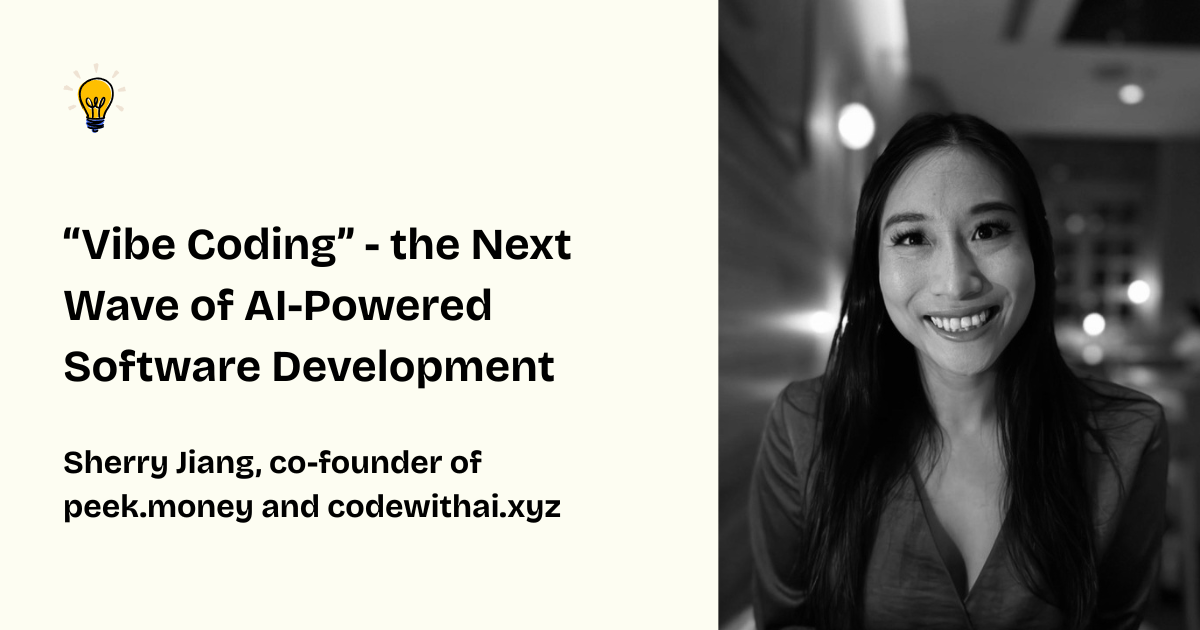


In the race to build, speed is the ultimate unfair advantage. We sat down with Sherry Jiang, a Singapore based founder who is redefining software development for a new generation.
As the creator of peek.money and the codewithai.xyz platform, she is a leading voice in the vibe coding movement – a development philosophy that emphasizes intuition, rapid iteration, and AI-assisted creation over traditional, methodical programming.
Vibe coding prioritizes shipping quickly and learning through building, leveraging AI tools to transform ideas into working products at unprecedented speed.
An official ambassador for Cursor, Sherry isn’t just talking about the future, she’s building a community dedicated to it, empowering founders and developers through hands-on workshops.
How would you explain “vibe coding” to a founder in a 30-second elevator pitch?
Vibe coding is one of the biggest shifts in software development in the last few decades, as it lets anybody turn an idea into a working prototype in minutes instead of weeks. You don’t need to be a traditional engineer to build – but you still need systems thinking, taste, and curiosity. Overall, it lowers the barrier to build, raises the bar for taste and iteration speed.
You’re the founder of peek.money. How has embracing the vibe coding directly impacted your own startup’s speed and development process?
Embracing vibe coding completely changed how we build at Peek. Our first prototype was done in three hours – it was raw but real enough to show users and helped us raise our first $275K to start building. Now our whole team uses vibe coding, and it’s compressed everything from six-month timelines to six weeks – or sometimes just hours. We run sprints in days instead of months. Because everyone is code-fluent, decisions happen faster and ideas don’t get stuck in translation. That speed is our edge – especially in a space like Peek, where we’re inventing new interaction patterns for personal finance. The only way to survive is to move fast, test constantly, and keep learning in real time.
Many developers use Copilot. What fundamental shift happens when a team moves from a standard IDE with a plugin to an AI-native editor like Cursor?
The shift from using Copilot in a standard IDE to building inside an AI-native editor like Cursor is night and day. Copilot feels like autocomplete at 10x speed – it helps you code faster, but you’re still the driver. Cursor changes the entire workflow because it’s built on conversation and iteration with a coding agent. 95% of the time you’re not writing the code, but instead collaborating with and supervising the AI to do most of the heavy lifting – planning, prototyping, debugging, refactoring and more.
V0 by Vercel seems almost like magic for UI development. Where do you see it having the biggest impact for early-stage startups trying to find product-market fit?
V0 is a cheat code for early-stage teams. It kills the gap between idea and interface, where you could “show” rather than “tell” which is more powerful than pitch decks, Figma mockups, or PRDs. You can go from concept to something testable in hours and get real user feedback instantly. That kind of speed compounds. Small but elite early-stage teams suddenly have enormous leverage, eroding the traditional advantages of larger companies. If you’re getting 10x throughput and 10x decision-making speed, that’s a 100x multiplier overall.
What are the current limitations of these tools? Where do developers still need to be “hands-on,” and where does the “vibe” approach fall short?
The main limitation right now is that these tools don’t think for you – they just make it faster to externalize your thinking. You still need taste, judgment, and structure. AI can remix patterns, but it can’t yet decide why something should exist or how it should feel.
For more complex systems or edge cases – infra, performance, deep integrations – you still need engineers who understand the guts. Vibe coding excels at fast loops and creative exploration, but it’s not yet great at precision engineering or long-term maintainability.
How does this new paradigm change the way founders should think about hiring engineers? Are you looking for a different kind of skill set now?
It’s completely changing how I think about hiring. You can’t just hire people who know syntax or algorithms anymore – you’re looking for people with taste and orchestration. The real edge now comes from engineers who can think in systems, vibe with AI, and make good product calls fast.
Everyone’s baseline is upleveled because automation handles so much of the repetitive work. The differentiator isn’t raw coding ability – it’s judgment, taste, and how well someone can collaborate with AI and others. Specialization matters less; adaptability and product intuition matter more.
We saw this firsthand at the Cursor Hackathon we ran in Singapore – a 24-hour build event backed by Cursor, OpenAI, DeepMind, and Anthropic. Over 400 participants joined, and most of the top projects came from solo or two-person teams, not large squads. Many weren’t traditional developers at all – they just had strong product sense and worked fluently with AI. That was the clearest proof that this new paradigm rewards taste, speed, and collaboration over headcount. One sharp builder with the right mindset can now do what it used to take a full team to pull off.
For a founder with a small team, what’s the first, most practical step to introduce vibe coding into their workflow without causing major disruption?
Honestly, there’s no gentle way to do it – you have to disrupt. If you try to ease into it, you’ll never catch up. Every six months you wait feels like six years of falling behind. The teams that lean in early build compounding skill and speed that others can’t replicate later.
The most practical first step is to lead by example. I didn’t roll out a “vibe coding policy” – I just started building in front of my team. When your non-technical founder is shipping prototypes in hours, it either inspires or terrifies people – but either way, it moves them. Once people see what’s possible, curiosity spreads naturally.
What are the biggest pushbacks or challenges you see from developers when they first encounter this new way of working, and how do you overcome them?
For my team, it hasn’t really been an issue – we’re already all-in on this way of building. But for a lot of developers, the pushback usually comes from a sense of loss of control. It’s not just a workflow change; it’s an identity shift. When you’ve spent years mastering syntax and precision, it’s hard to accept that the tools can now do in seconds what used to take you hours.
Many feel like the quality isn’t as good as what they’d write by hand. But that’s missing the bigger picture. Coding is becoming what woodworking or hand-sewing used to be – still an art, still respected, but no longer the bottleneck to creation. The value moves up the stack – to design, orchestration, and taste.
As AI handles more of the boilerplate, what are the new “superpower” skills that developers should be focusing on to stay valuable and thrive?
Developers who’ll thrive are the ones who think in systems. They can zoom out, connect dots, and design flows that make sense across product, data, and user behavior.
Taste becomes the new leverage – knowing what good feels like, not just what works. And adaptability is everything. The best engineers will evolve their identity from “code writer” to “problem shaper.”
For developers who want to learn vibe coding but can’t attend a codewithai.xyz workshop, what are the best self-learning resources or side projects you’d recommend to get started?
Download Cursor, watch Riley Brown on YouTube, and try to build your own app. There is no substitute for building to learn here.
What are some of the most impressive projects your students have been able to build in a single weekend after a workshop?
- App with full Whatsapp integration
- AI poop tracker for gut health
What is the single biggest mistake founders are making right now when it comes to adopting AI in their engineering teams?
Not pushing them hard enough or making them uncomfortable because that’s how change happens.