



In the high-stakes world of early-stage startups, we obsess over “technical debt” or the messy code that will eventually crash the system if left unfixed. But we rarely talk about “leadership debt” – the accumulated stress, blind spots, and emotional rigidities that eventually crash the founder.
Most founders treat executive coaching as a luxury item or a remedial punishment. They see it as “paid venting” for people who can’t handle the heat. But look at the cap tables of the world’s most successful unicorns, and you’ll find a different story.
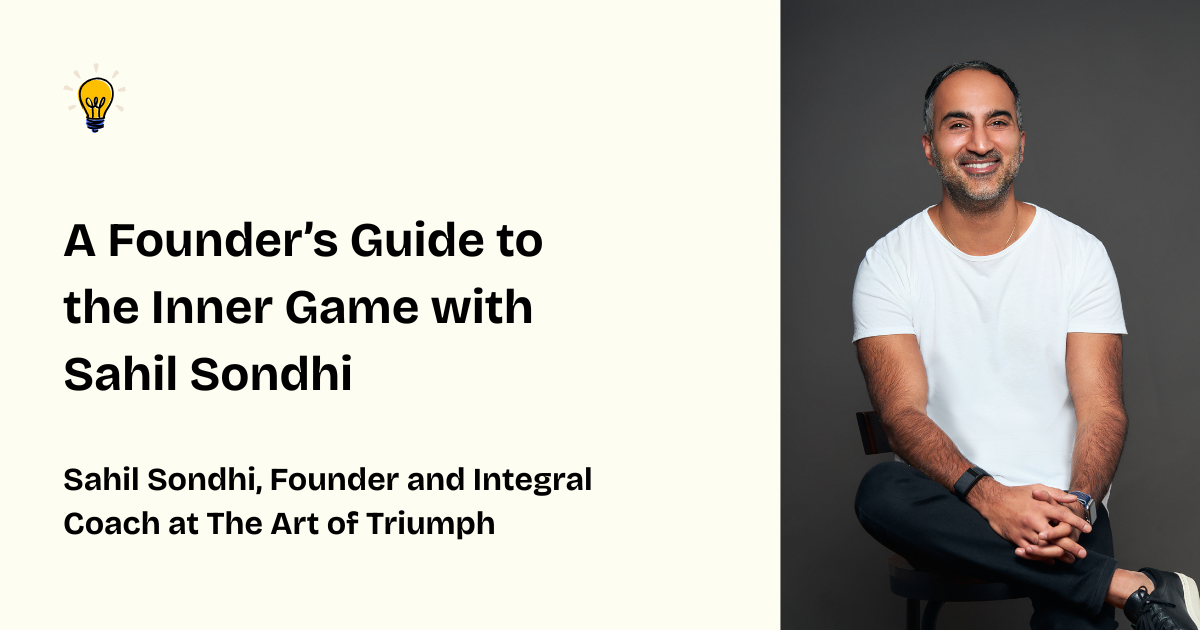
To demystify this industry, we sat down with Sahil Sondhi, a certified Integral Coach® and the founder of The Art of Triumph. Sahil specializes in working with tech executives to upgrade their internal operating systems. We asked him the hard questions about ROI, the difference between coaching and therapy, and why smart founders often have the biggest blind spots.
If you had to explain executive coaching to a skeptical person who thinks it’s just “paid venting” or “soft skills fluff,” how would you describe the mechanics of what you actually do?
A lot of what gets called coaching today is tactical or technical in nature, rather than developmental. The work I do is developmental. I focus on helping leaders develop in a deep, holistic way. So instead of focusing on quick tactical fixes or a space to vent, I help leaders look at the deeper structures which shape how they think, feel, make decisions, relate to others, and respond under pressure, uncertainty and complexity. This is sometimes referred to as the “internal operating system” which I think is a useful phrasing. Most of us try to improve ourselves by working on surface tactics. But the real leverage lies in what I call the “trunk of the tree” rather than the particular branches or leaves – the way we’re built to think, feel, and show up when things get hard.
In practice, this means understanding how someone operates today, determining what capacities they’ll need for the next stage of leadership and life, and then building those capacities in a sustained way through simple, manageable practices. Over time, this creates very tangible, observable shifts how someone thinks, communicates and leads, both at work and at home.
There is a common saying that “therapy is for the past, and coaching is for the future.” As an Integral Coach who goes deeper than just surface-level tactics, do you find that distinction holds up, or is the line blurrier than people admit?
The distinction does hold up but there are important nuances. First, there are many types of both therapy and coaching. Typically, people compare some form of psychotherapy with some type of developmental coaching. Here, therapy does tend to be more backward-looking and focuses on past sources of present suffering. This can be incredibly powerful.
Developmental coaching, within which Integral Coaching® is one of the pioneering methodologies, is definitely more forward-looking and focused on building new capacities and ways of being through a structured approach that creates lasting change.
Because therapy and coaching often differ in their emphasis on past versus future, the outcomes you’re aiming for will also tend to differ. However, there are some areas of overlap, whereby the different approaches can help you to achieve similar goals.
For example, if you’re dealing with childhood trauma, therapy is probably the way to go. If you’re enhancing your relational capacity to influence and persuade, coaching is ideal. And if you’re learning to stay calm and grounded during difficult conversations and events, you might find either approach to be helpful.
Many founders believe they only need a coach when something is on fire, a co-founder dispute, a missed round, or burnout. Can you explain the difference between coaching for repair versus coaching for elite performance?
A lot of founders seek out coaching when something’s already on fire, such as a co-founder dispute, a missed funding round, or just plain burnout. In fact, most founders come to me because something is wrong, not because they’re trying to be proactive about their own development. And that’s totally understandable – as humans we tend to seek out help when the need is real and present, not distant or abstract.
However, once we’ve sought out external help, there is a big difference between coaching for immediate troubleshooting and coaching for long-term development. In developmental coaching, we’re not just putting out today’s fire. We’re actually building the internal capacities and awareness to tackle such challenges – and others like them – more skillfully, and perhaps prevent them from escalating in the first place.
So, yes, people often come in for the “repair,” but what they leave with is a whole new level of leadership capacity – one that allows them to more skillfully navigate whatever fires they may encounter.
You are a certified Integral Coach®. Can you explain exactly what the “Integral” methodology is, and why this framework is more effective at shifting behavior?
Integral Coaching® is a methodology developed over the past 40 years by New Ventures West in San Francisco, one of the world’s oldest coaching schools for developmental coaching. What makes it “integral” is that it looks at the whole person – their thoughts, feelings, embodied experience, relationships, and environment – in a structured and practical way. It’s a blend of practical philosophy and biology in which we examine how people make sense of their world and how they embody dramatically different ways of being.
In practice, this means we start by understanding how a person currently sees and responds to different areas of their life. Then we identify the developmental capacities that will make the biggest difference for them as leaders and human beings. We design a six-month journey that includes meeting regularly and weaving in simple yet potent practices into their daily lives and routines. Over time, this builds the intended competencies in an incremental yet highly compounding way.
In other words, Integral Coaching® is about going deep into a person’s internal narratives and patterns, and helping them transform in a way that touches all areas of their life. It’s a holistic and deeply grounded approach that creates the conditions for meaningful, lasting development. The neuroscience has come a long way in supporting this kind of integral, whole-person growth, showing that sustainable change really does come from working deeply and holistically.
Tech founders often live entirely in their heads. How do you get a highly cerebral founder to connect with the physical or somatic signals of leadership, like stress or gut instinct, without it feeling too “woo-woo” for them?
In modern society, we’re generally taught to rely almost entirely on our conscious mind. But the reality is that the conscious mind is just a small part of our entire nervous system, which extends throughout the body and includes a range of subconscious processes along with a wealth of perception and intelligence.
In coaching, I do very simple practices with my clients to help them to reconnect with that whole system, which we often refer to as somatic intelligence. As they engage with these simple exercises, both in our sessions and in daily life, they learn to pay attention not just to their conscious thoughts, but to the signals and wisdom that the entire system is offering, often through the physical body.
Over time, this means they can tap into deeper levels of awareness and capacity that go beyond what feels purely “mental.” It’s not about anything “woo-woo” but rather it’s about reclaiming the full range of our natural human capacity. The last few decades of neuroscience research have produced tremendous progress in our understanding of all this, but that research and understanding takes time to trickle down into the rest of society. Coaching, books and podcasts are some of the key ways in which such knowledge is gradually making its way into society.
In your experience working with high-IQ tech executives, what is the single most common “blind spot” that intelligent founders fail to see in themselves?
One of the biggest blind spots I see, not just in founders but in most of us, is the subtle belief that personal and leadership growth will just happen naturally if we leave it to chance. There’s this idea that because we’re smart or capable, we’ll somehow evolve all the capacities we need over time. But the reality is that such development doesn’t happen optimally without us paying conscious attention to it. We have to proactively engage with our own development if we want to lead and live at our best.
The second piece is that founders and executives often have a track record of success that reinforces this belief. They’ve gotten this far by relying on what’s worked before, and it’s natural to think they can just keep doing the same and continue to grow. But the skills that got them here aren’t always the ones that will get them to the next level. At a certain point, what’s needed is a whole new layer of deeper human capacities and awareness. And that kind of growth really does require conscious, proactive engagement, not just leaving it to chance. There are many ways to do that, and coaching is certainly one very effective path, among others.
On a personal note, I learned this the hard way myself. For a long time, I didn’t pay enough attention to my own development as a human being and a leader. Eventually, life forced my hand, and I had to confront the fact that I’d stagnated in these core capacities. This is part of what led me to become a coach: to help others avoid that same trap and to develop the capacities I realized were so important.
There is a brutal transition phase, usually around 20 to 50 employees, where a founder has to stop building the product and start managing the organization. What is the biggest psychological hurdle founders face during this switch?
One big hurdle is the skill shift. Founders have to go from being hands-on builders and doers to leading and managing the people who now do those activities. This requires a whole new set of skills around handling complex human dynamics, fostering healthy team culture, and navigating relationships at a larger scale. It’s a major shift from “I build the thing” to “I build the conditions in which other people can build and thrive.”
Beneath that, there’s also an emotional and identity-based shift. Many founders carry a deep identification with being the person who ships the product, closes the deals, and knows every detail. Stepping back from that can feel like losing contact with the narrative they’ve held about who they are as a leader. It can bring up significant discomfort such as loss of control, doubt and frustration, which make it hard to fully embrace and thrive in their new role.
As humans, we carry a deep, ingrained bias toward continuing the patterns that have served us in the past, so facing these shifts head-on can feel deeply uncomfortable, even for very capable founders.
Founders often feel isolated because they can’t be fully transparent with their board (fear of losing confidence) or their team (fear of causing panic). How do you create a container where they can be honest without feeling like they are signaling weakness?
Creating a space where a founder feels safe to be fully transparent is, in many ways, the most foundational part of the coaching relationship. Before any particular coaching model or method comes into play, there’s a kind of container that you co-create together. The coaching container isn’t built through any magic formula – it emerges from a coach’s natural curiosity, perception, and thoughtfulness, and from the rapport and trust you build together.
For many founders, this container becomes one of the only places where they can speak openly without worrying about spooking their team or losing the confidence of their investors. In my experience, this type of container is something I’ve found myself naturally creating with leaders throughout my career.
But it’s also important to acknowledge that not every coach is the right fit for every client. That’s why the initial chemistry or discovery call is so critical: it’s where we see if we can co-create that space together. If we can, then that becomes the foundation on which real honesty and growth can happen.
Startup culture glorifies the grind. How do you help a founder distinguish between “healthy grit” that drives growth and “toxic stress” that is actually degrading their cognitive ability to make good decisions?
Distinguishing between healthy grit and toxic stress often begins with looking at the real impact of a founder’s current way of operating. When a leader is running on toxic stress, it eventually shows up in other parts of their life – their health, sleep, relationships, and overall sense of well-being. Once those areas begin to deteriorate, it’s only a matter of time before clarity, presence, and decision-making at work are affected as well.
In a coaching engagement, clients learn simple but powerful ways of regularly reflecting on these signals. As they build this habit, they start noticing much earlier when they’re tipping from healthy intensity into an unhealthy mode that is quietly eroding their effectiveness. They develop a much clearer felt sense of healthy grit versus the kind of stress that quietly degrades their judgment.
The impact isn’t limited to the founder. When a leader is operating from toxic stress, the effects ripple through the company – the team often feels it long before the leader does. Bringing reflective practices and honest feedback conversations into the leadership team creates a shared ability to course-correct early, so the company as a whole can sustain healthy, high-quality performance rather than burning itself out.
Investors love metrics. How should a founder measure the ROI of their coaching engagement? Is it purely qualitative—just feeling better—or can we tie it to tangible business outcomes?
Measuring ROI in coaching is important, but it’s rarely a clean attribution exercise. There’s no A/B test where we can compare a founder’s current reality with an alternate version of their life without coaching. So the question isn’t, “Did coaching cause this exact outcome?” but rather, “What observable changes have occurred in my behavior and my decision-making, and how are these influencing the outcomes I’m creating?”
I once worked with an early-stage founder on some core relational skills. A few months after our engagement ended, he told me his closing rate had tripled and his relationships at home felt much closer. His team and family independently attributed these changes to coaching. But as with any developmental work, the precise extent to which coaching drove the outcomes comes down to a reasonable, good-faith assessment rather than a perfect empirical measure.
And thus, measuring ROI is really about looking across the domains that matter – decision-making, team dynamics, relationships, resilience, and tangible business outcomes – and asking whether the founder is showing up in a way that consistently produces better results. When the internal operating system shifts, the external results tend to shift with it.
Have you ever had to turn away a potential client? What are the traits or mindsets that make a founder “uncoachable”?
One of the biggest factors in a successful coaching engagement is a client’s genuine commitment to their own development and their openness to trying new ways of seeing and doing things. By the time a prospective client reaches out for a discovery call, there is usually already some desire for meaningful change. That willingness is essential because coaching works best when the client is actively engaged in their own growth.
The chemistry between the coach and the client also matters a great deal. The most effective coaching containers are built on openness, trust, and a natural sense of rapport. Not every coach is the right fit for every client, and that’s completely normal. The chemistry call is where we explore whether we can genuinely build that kind of space together. If it’s not the right fit, I’ll refer the founder to another coach with whom they may have a better chemistry. The priority is always to create the best possible environment for a client’s development. The only time I’d consider someone truly ‘uncoachable’ is if they genuinely have no interest in their own development or are unwilling to look at their part in the patterns they’re facing.
For a founder reading this who is on the fence about hiring a coach, what is one question they should ask themselves today to determine if they are ready for this kind of work?
One simple way to know if you’re ready for this kind of work is to ask yourself: Am I willing to be open and honest – and even a bit vulnerable – about what’s happening in my life and leadership? And am I willing to try new things?
Coaching isn’t about already being at some ideal starting point. It’s about being willing to explore, reflect, and experiment with new ways of seeing and doing things. If a founder can show up with even a little openness and curiosity – and a willingness to engage sincerely with the process – then they’re already in a good place to begin.